
I started decorating textiles as a teenager because I never found fabrics in New Zealand that expressed what I wanted to express. The limited designs available at the time did not tell a story I could relate to, so I started painting on fabric. It began with clothing, bedding and small gift items, and when I mastered screen printing, I began decorating larger pieces and printing multiples to sell.
I have now been doing this for more than thirty years. That realisation stopped me in my tracks recently. Not because I expected anything different — fabric has never felt like a choice exactly — but because thirty years is long enough to see an entire industry shift around you, and to understand what it cost to stay true to something through all of it.

From the beginning, I knew I only wanted to work with fabrics that weren't contributing to the industry standard of high chemical use and exploitative labour. I was the first artist and printer in New Zealand to use organic cotton as a base cloth for tea towels — happy for anyone to prove me wrong. In the 1990s and early 2000s, most people hadn't heard of organic cotton. That has changed considerably — tariffs have lifted, technology has advanced, and there is a genuine market now that simply didn't exist when I started. But I was working in that space long before it had a name.
The business side I had to learn as I went. My practice grew alongside raising my family. We built a purpose-built studio in the Waikato and I developed my signature range of New Zealand prints — flora, fauna, landscapes, and the particular colours of this place. My Pohutukawa, Kowhai and Manuka prints are from this period. I intended to create timeless designs and, even though I've failed at many things, I haven't failed at that. They are still bestsellers twenty-plus years on. I'm about to bring a couple back — they still look fresh, even in a crowded market.

When we relocated to Auckland in 2010, I shifted focus toward building something more sustainable as a business. My tea towel range kept growing. Many of the designs came from woodblock printing and hand-drawn work — I wanted the craft of the artist visible in the print, and that hasn't changed. My prints are still made by hand before they go anywhere near fabric.
For a while, the point of difference was simply that I was printing everything myself. So I leaned into that and printed more and more — all by hand. In 2014, a distributor approached me wanting to market my tea towels, which was a relief. Constantly switching between maker and seller is its own kind of exhaustion. I invested in a carousel, and my studio was perpetually covered in drying tea towels. I could hardly move sometimes. I was also doing bespoke printing for designers and the public, working on my New Zealand-made table linen range, trying to find time for new designs, and some teaching alongside all of it.

But the base cloth problem never went away. The more I printed, the less time I had for design — and nobody was importing the cotton I wanted. I kept searching. I eventually found a manufacturer in India and tested them through a contract print for a brand based in Vanuatu. I lost a client and gained a potential manufacturer.
Then in 2016, my body stopped.
One day, while out with my son, I felt a tightness and a lingering pain in my neck. By midnight, it was excruciating, and I couldn't move. We called an ambulance. They gave me serious painkillers but there wasn't much else to be done. It felt like my body had stored up so much — the physical repetition of printing, the stress of running everything alone, the financial yo-yo of doing it all, years of it — and had simply seized. Progress came in increments almost too small to measure. Being able to get out of bed. To bend down. To wash. Water in my hair or cleaning my teeth would set off fresh waves of pain. I couldn't drive. When I was eventually able to get to my studio, I had to be taken there, and the journey itself was painful.
I couldn't print. I knew things had to change.

I'm not one to dwell, but I had a lot to sit with. Around this time, I came across Michael Gerber's The E-Myth and recognised myself immediately — the classic trap of doing everything yourself until the doing undoes you. I had to resist the failure feeling and all the thoughts that come with it. My Buddhist practice helped keep the creativity alive. But I still had a lot to learn about truly believing in myself and asking for help.
There was a fork in the road. The smarter business move, in retrospect, would have been to claim the insurance I had — and had genuinely forgotten about — use it to pay a contractor to keep printing while I recovered, and decide what to do from a position of stability. But I was suffering, and I retreated. I let the stock run out. I closed the studio. I worked in retail for two years and used that time to make more designs and begin the long process of getting the fabric sampling right with my contact in India.
In 2018, I invested in a shipment of organic cotton tea towels made to my specifications, GOTS certified, from India. I finally had the product I had always been working toward. One hundred per cent.
Returning to the market after nearly two years was harder than I expected. Many retailers who had stocked my work didn't want to come back once the tea towels were no longer printed by me (and so much better!). I respect that position, and I also want to address it directly.
New Zealand does not have a textile industry in the way people imagine. 'NZ Made' in textiles means importing fabric and assembling it here. The more honest question — for a country as import-dependent as ours — is not where something was made, but how. Why print on substandard cloth produced through chemical-heavy farming and labour that keeps people in poverty, just to say it was finished here? The base cloth is the foundation. It always has been for me.

One more thing on this, because it matters: organic cotton is more common now, but the confusion is about whether it's genuine. Only GOTS-certified cotton is. Many labels say 'organic cotton' or include an organic element, but without regulation, it could mean as little as five per cent. The lobbyists who fight against regulation are, in the end, the enemy of people and planet. Cutting costs doesn't eliminate them — it shifts them to someone else. The history of textile production is largely a history of that cost being externalised, and mostly onto women.
I found new stockists. I felt more confident in the quality than I ever had. I also began developing a brand strategy framework and started working with a colleague at her design agency. Then I had an opportunity to join New Zealand Opera as Marketing Manager — the other side of my skills had space to develop. I carried on making art.
Then COVID arrived and dismantled what I'd rebuilt in a matter of months.
Before the lockdowns, my husband and I had sold our house. We needed more space, and we were not sure where we wanted to be long-term, but wanted to commit fully to our creative lives — his and mine both. It was a deliberate sacrifice: we chose space and time over any conventional idea of wealth or security. We didn't know what was coming.
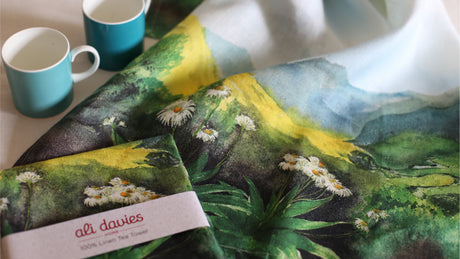
When Auckland locked down, the road trip I had planned to visit retailers — the one I'd left NZ Opera to do, funded by a big tea towel sale — was cancelled three days after my final day at the company. Just like that. Our savings from the house sale were going fast. The market mostly stopped, but I didn't. I explored digital printing on linen, commissioned a collection of watercolour artworks from another artist, and kept working across drawing, websites, and freelance brand strategy. I held things together.
An artist needs time and space to work. A business needs sales. A human needs food, shelter, and clothing. I work at the intersection of these often contradictory needs. This is my story, and it isn't over.
The linen range that came out of that period is now a solid part of my collection — I see it as an essential contemporary offering alongside the organic cotton. The commissioned watercolour work opened something up for me too: I now work with other artists, helping them find and articulate what makes their practice distinct. I've come to love that work. It turns out that thirty years of navigating all of this teaches you something worth passing on.

Over those thirty years, I've accumulated more designs than I can count, worked across print, illustration, bespoke commissions in film, TV and theatre, fashion, schools, and independent brands. My Patterns of New Zealand collection is stocked in stores across the country. The Pohutukawa design, which started in a Waikato studio, has become the emblem of the brand. I still find that surprising.
I still have debt I'm working through. I've made financial decisions I wouldn't make again. But I'm a person who learns by doing, and I'm still doing it — motivated, inspired, and clear on what this is for.
I am not a printer. I am an artist who uses textiles as her medium — and that is rarer in this country than most people realise. There is no job like this here. One has to create it and decide what to sacrifice.
The work I make tells stories of New Zealand. It travels around the world. It is present at the kitchen table, at celebrations, at the small daily occasions that accumulate into a life.
That teenager who couldn't find fabric that resonated is still here. She never really stopped looking.
Ali Davies


4 comments
Loved seeing you share your story Ali. Hope things pick up for you, and you definitely deserve it! Your product is beautiful and you should be very proud of it.
I have bought from you at the Oratia markets
Thoroughly enjoying my table napkins along with a tray cloth. The texture and quality of the material and pattern so elegant.
Look forward to more inspiration for my table settings
Cheers Elaine.
I love your work and have bought tea towels both for myself and as gifts but I hadn’t realised the blood, sweat and tears – and pain – that went into making and distributing them. Thank you so much – and the tea towels are the best I’ve ever used, by the way!
I love your work and have bought tea towels both for myself and as gifts but I hadn’t realised the blood, sweat and tears – and pain – that went into making and distributing them. Thank you so much – and the tea towels are the best I’ve ever used, by the way!